A toolbox talk ends with silence, blank stares, and five minutes later—everyone back to risky shortcuts. This isn’t failure. It’s the default. Most safety briefings fail because they’re treated as compliance checkboxes, not communication opportunities. But when done right, a toolbox talk doesn’t just check a box—it changes behavior. This guide shows exactly how to do a toolbox talk that sticks, engages, and reduces on-the-job risk.
Why Most Toolbox Talks Fail
Toolbox talks are often rushed, recycled, or read verbatim from a generic template. Workers zone out because they’ve heard the same message 20 times. The speaker drones on without eye contact. No one asks questions. And the moment the meeting ends, the message evaporates.
Common breakdowns: - Too broad: “General safety” isn’t actionable. - No relevance: Talking about fall protection on a day everyone’s doing electrical work. - One-way delivery: No interaction, no questions, no engagement. - Poor timing: Scheduled at the end of the shift when everyone’s fatigued. - No follow-up: No reinforcement or accountability.
The solution isn’t more meetings. It’s better ones.
What Is a Toolbox Talk (And What It’s Not)
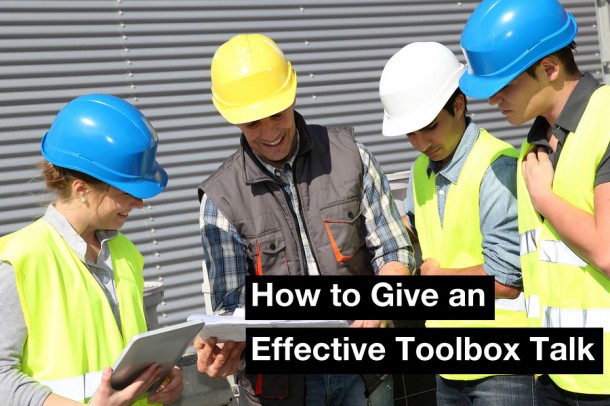
A toolbox talk is a short, informal safety meeting—usually 10 to 15 minutes—held at the job site before work begins. It focuses on a single, specific hazard or safe work practice relevant to that day’s tasks.
It’s not: - A lecture - A compliance ritual - A time to read policy documents
It is: - A conversation about real risks - A chance to align the team - A tool for frontline leadership
When you know how to do a toolbox talk right, it becomes a daily ritual that builds safety culture—one conversation at a time.
Step-by-Step: How to Do a Toolbox Talk
#### 1. Pick a Focused Topic
Choose one specific hazard, not ten. Match it to the day’s work.
Examples: - “Safe ladder use on uneven ground” - “Lockout/tagout for conveyor maintenance” - “Proper lifting technique in tight spaces”
Avoid vague topics like “Stay safe today.” Specificity drives behavior change.
#### 2. Know Your Audience
Are you talking to experienced electricians? New hires? A mixed crew? Adjust language and examples accordingly.
Example: For a crew replacing roof tiles, focus on edge protection, not confined space entry.
#### 3. Prepare in Advance
Don’t wing it. Spend 10 minutes preparing:
- Review the task
- Identify key risks
- Think of a real incident (near miss or injury) related to the topic
- Bring a visual if possible—a photo, a glove with a tear, a damaged tool
Preparation signals respect. It says: This matters.
#### 4. Start with a Real Story
Open with a brief, real-world example.
“Last week, a worker in Calgary lost his balance on a slippery roof. He wasn’t tied off. He fell 12 feet. Broke two ribs. Could’ve been worse.”
Now the team is listening. Stories activate emotion—and memory.
#### 5. Engage the Team
Ask questions. Don’t lecture.
- “Has anyone here worked on a roof like this before?”
- “What would you do if your harness didn’t fit right?”
- “Where’s the nearest anchor point?”
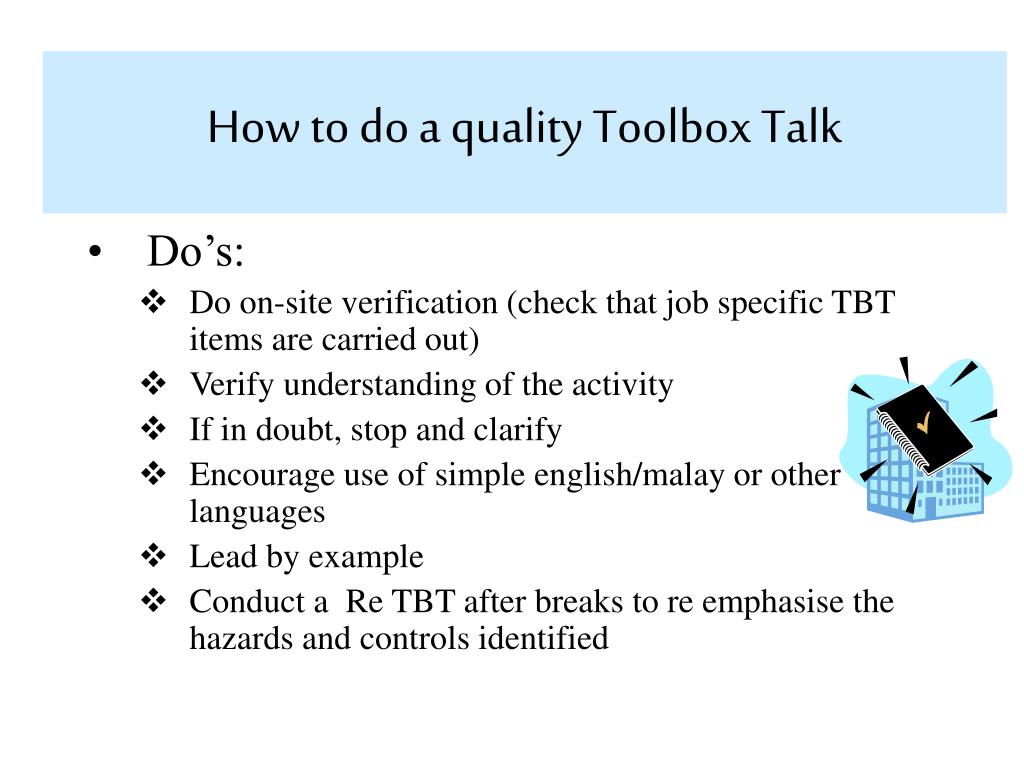
Let workers share experiences. Peer input is more influential than top-down instruction.
#### 6. Demonstrate When Possible
Show, don’t just tell.
- Put on a harness and point out the D-ring check
- Demonstrate how to inspect a ladder’s feet
- Use a damaged tool to show what to look for
Visuals increase retention by up to 75%, according to OSHA research.
#### 7. Confirm Understanding
Don’t assume people get it. Ask:
- “What’s one thing you’ll do differently today?”
- “Who’s responsible for checking ladders before use?”
If answers are vague, clarify.
#### 8. Document the Talk
Even if brief, record: - Date - Topic - Attendees - Key points discussed
This isn’t for bureaucracy—it’s for accountability and trend tracking. If you see repeated issues (e.g., PPE non-compliance), you can address root causes.
Real-World Example: Confined Space Entry
Scenario: A maintenance team is entering a storage tank to clean residue.
Toolbox Talk Flow:
- Topic: “Safe entry into confined spaces—today’s tank cleaning”
- Story: “In 2022, three workers in Texas were overcome by fumes in a silo. One died. Atmosphere wasn’t tested.”
- Risks: Low oxygen, toxic fumes, entrapment
- Questions:
- - “Who’s the attendant?”
- - “Is the gas monitor calibrated?”
- - “What’s the rescue plan if someone collapses?”
- Demo: Show how to use the gas detector, test it live
- Check: “Who signs the permit? Who monitors entry time?”
- Close: “If in doubt, stop and call the supervisor. No heroics.”
This isn’t theoretical. It’s survival.
Common Mistakes (And How to Avoid Them)
| Mistake | Fix |
|---|---|
| Talking too long | Keep it under 15 minutes |
| One person doing all the talking | Ask questions, rotate facilitators |
| Using jargon | Use plain language |
| Repeating the same topic weekly | Rotate topics based on risk |
| No follow-up | Walk the site later—see if practices changed |
One crew reduced near misses by 40% in three months just by rotating toolbox talk leaders weekly. New voices brought fresh perspective.
When to Hold a Toolbox Talk
Timing affects impact. Best moments:
- Before a high-risk task (e.g., hot work, working at height)
- When conditions change (e.g., rain, new crew, shift change)
- After a near miss or incident
- When introducing new equipment or procedures
Example: A crane operator notices high winds at 8:15 AM. Before the lift, the supervisor calls a 10-minute talk on wind safety—checking load charts, securing materials, abort criteria.
Proactive talks prevent problems. Reactive ones reinforce learning.
Who Should Lead the Talk?
It doesn’t have to be the supervisor.
Best leaders: - Know the work - Speak clearly - Encourage input - Model safe behavior
Empower experienced workers to lead. One oil refinery trained six senior technicians to run talks. Within months, engagement scores doubled. Workers trusted peers more than managers.
Leadership isn’t a title. It’s influence.
Making It Stick: Beyond the 15 Minutes
A toolbox talk isn’t over when the meeting ends.
Do this after: - Walk the site to observe adherence - Praise safe behavior when you see it - Address gaps immediately - Revisit the topic in the next week’s talk if needed
Example: After a talk on glove use, a lead notices two workers aren’t wearing cut-resistant gloves. Instead of reprimanding, he asks: “Remember yesterday’s talk about hand injuries? Let’s grab the right gloves together.”
That’s reinforcement—not punishment.
Tools and Templates That Help
While no app replaces human interaction, these resources support consistency:
| Tool | Use Case | Pros | Cons |
|---|---|---|---|
| SafetyCulture (iAuditor) | Digital checklists and talk logs | Real-time reporting, photo uploads | Requires devices |
| Procore | Construction-focused safety module | Integrates with project plans | Complex setup |
| SiteDocs | Pre-built toolbox talk templates | Offline access, audit-ready | Subscription cost |
| ClickSafety Toolbox Talks | OSHA-aligned topics | Easy to use, no training needed | Less customizable |
| Custom PDF templates | Simple, printable checklists | No tech needed | Hard to track |
Choose based on your team’s size, tech access, and workflow. The best tool is the one actually used.
Final Thoughts: Do It Every Time, Do It Right
Knowing how to do a toolbox talk isn’t about ticking a box. It’s about changing outcomes. A great talk takes 10 minutes. A forgotten one takes the same time—and achieves nothing.
Do it right: - Make it relevant - Make it real - Make it interactive - Follow through
Your crew doesn’t need another safety speech. They need a conversation that prepares them to go home safe.
Start tomorrow: pick one hazard, gather the team, ask one question, listen, and act. That’s how safety culture grows.
FAQ
What should you look for in How to Do a Toolbox Talk That Actually Works? Focus on relevance, practical value, and how well the solution matches real user intent.
Is How to Do a Toolbox Talk That Actually Works suitable for beginners? That depends on the workflow, but a clear step-by-step approach usually makes it easier to start.
How do you compare options around How to Do a Toolbox Talk That Actually Works? Compare features, trust signals, limitations, pricing, and ease of implementation.
What mistakes should you avoid? Avoid generic choices, weak validation, and decisions based only on marketing claims.
What is the next best step? Shortlist the most relevant options, validate them quickly, and refine from real-world results.